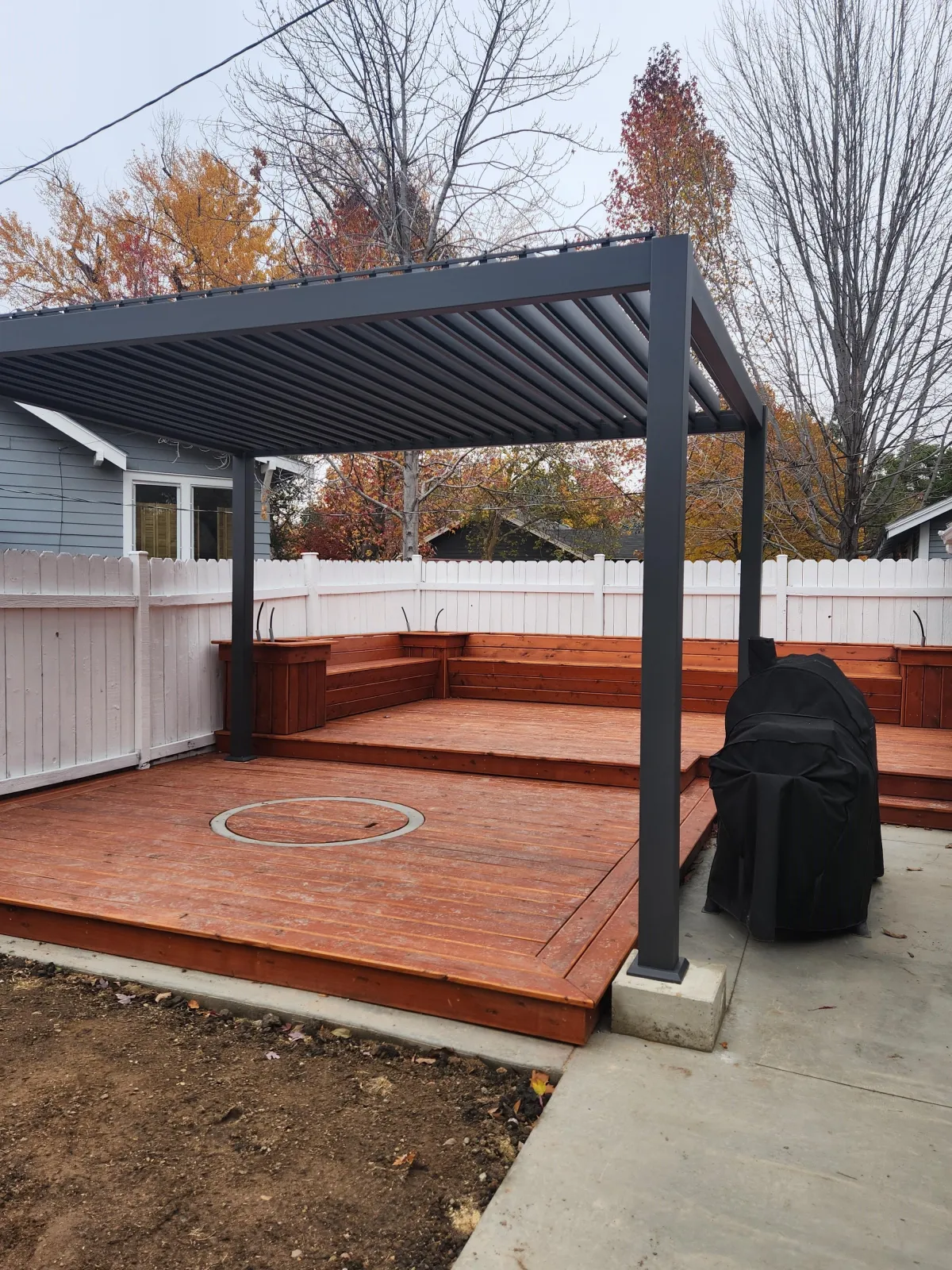
Retractable Patio Covers in Boise
Boise backyards are made for real life—weekday dinners outside, kids running between the lawn and the deck, friends lingering after sunset, and that first warm Saturday when you’re determined to “start summer early.” The challenge is that our weather doesn’t always cooperate. The sun can feel intense by late spring, foothills winds show up without warning, and a surprise shower can send everyone scrambling.
That’s exactly why retractable patio covers have become one of the most requested outdoor living Boise upgrades we build around. They give you control. Full shade when you need it, open sky when you want it—without committing to a permanent roof that can darken your interior rooms or change the look of your home.
At Decked Out, we design and build outdoor spaces that last. As a deck builder in Boise serving the Treasure Valley for nearly 30 years (and sister company to Renaissance Remodeling), we’ve learned that the best outdoor projects aren’t just beautiful—they’re engineered for our climate, tailored to the way you live, and detailed so they still perform years from now.
Retractable Patio Covers: What They Are, How They Work, and Why Boise Homeowners Love Them
Retractable patio covers are adjustable shade structures that extend and retract to control sun, heat, and light rain protection over a patio, deck, or outdoor living area. Think of them as “shade on demand”—a design-forward solution that makes your backyard more usable without locking you into one fixed condition.
The basic anatomy: frame, cover, rails, hardware, and controls
Most retractable patio cover systems include:
Structural frame (often aluminum or steel): The backbone that supports the cover and handles wind forces.
Guide rails or tension system: Keeps the cover stable as it moves.
The cover material: Typically fabric, PVC-coated fabric, or specialized membrane; in some systems it’s a canopy that gathers when retracted.
Mounting/attachment points: Either to the home (ledger/beam) or a freestanding structure with posts and footings.
Controls: Manual crank, pull-rod, or motorized remote/app control; many include wind/sun/rain sensors.
A high-quality system feels smooth, tight, and quiet. A bargain system often reveals itself in the details: flimsy brackets, noisy movement, sagging fabric, and hardware that doesn’t age well.
Manual vs. motorized retractable covers
Manual systems can be a good fit for smaller areas or tighter budgets. They’re simpler and reduce electrical planning.
Motorized systems are the premium choice for most Boise homeowners because you actually use them. If shade requires effort, it gets ignored. Motorized covers also open the door to wind sensors (a must in many parts of the Treasure Valley) and scheduled operation.
Awnings vs. pergola-style retractables vs. roof-style systems
Homeowners often use “retractable patio cover” to describe a few different products. The right choice depends on your structure, exposure, and design goals.
Retractable awnings: Typically wall-mounted, projecting outward with fabric shade. Clean, classic, and often the most cost-effective “big impact” option for patio shade solutions.
Pergola-style retractable canopies: A freestanding or attached pergola frame with a retractable canopy that slides on rails. Great for larger spans, modern aesthetics, and pairing with custom decks Boise families use as outdoor dining rooms.
Roof-style or rigid systems (and look-alikes): Some products feel “retractable” in function but aren’t fabric—like adjustable louvered roofs. They’re a different category, but they solve similar problems in a more all-weather way (we’ll break this down later).
If you want a simple rule: awnings are ideal for straightforward shade over a patio, while pergola-style retractables shine when you want a designed outdoor room with structure, lighting, and upgrades.
Why Retractable Patio Covers Make Sense in Boise’s Climate
Boise weather is one of the reasons people move here—and also why outdoor spaces need smarter planning. Retractable systems are popular because they adapt to the swings.
Sun and UV exposure in the Treasure Valley
The Treasure Valley gets strong sun and big blue skies. That’s a gift—until your deck surface feels too hot to enjoy or you’re constantly shifting chairs to chase shade. A retractable cover helps you:
Protect seating fabrics and finishes from UV fading
Reduce heat on decking and patio surfaces
Create comfortable dining shade at peak sun hours
For south- and west-facing yards (very common in Boise subdivisions), retractables can be the difference between “nice idea” and “we use it daily.”
Wind realities: foothills gusts and storm fronts
If you live closer to the foothills, on a ridgeline, or in an exposed backyard with long sightlines, you already know: wind can show up fast. Retractable covers must be chosen and installed with wind in mind:
Look for wind-rated systems and ask what the rating actually means in real use
Consider wind sensors that automatically retract the cover when gusts hit
Pay attention to anchoring and structural footings, especially for freestanding pergola-style systems
This is where a seasoned awnings Boise contractor or outdoor living builder makes the difference: the product matters, but the structure and installation details matter more.
Snow load and winter planning: what “4-season” really means
Boise winters vary year to year, but snow is part of the equation. Many fabric retractables are not designed to hold snow load. That doesn’t mean they’re a bad choice—it means you plan correctly:
Retract fabric covers in winter or during snow events unless the manufacturer explicitly rates it for snow load
For true winter capability, consider rigid roof solutions (or louvered systems) designed for precipitation
If you want a covered porch feel, we may steer you toward a porch build or a hybrid system rather than a simple awning
If “winter-ready” is a must, we’ll design the structure around that reality, not around marketing language.
Extending shoulder-season use (spring/fall)
This is the secret advantage in Boise: it’s not just about summer. A retractable cover paired with the right upgrades can make April feel comfortable and keep October dinners outside:
Add radiant heaters or a clean ceiling-mounted heater option
Use low-glare lighting so the space feels warm after sunset
Consider wind-blocking screens on the sides most exposed to breezes
That’s how an outdoor space becomes a real extension of the home—not a seasonal accessory.
Design Options That Actually Change Your Day-to-Day
The best-looking retractable patio cover is the one that matches how you use your backyard. Design isn’t just aesthetics—it’s deciding where you want shade at 6 p.m., how you move between the kitchen and grill, and what you’ll appreciate when guests stay an extra hour.
Full coverage vs. partial shade: planning for how you live
Before choosing a system, decide what the space is for:
Outdoor dining: Prioritize consistent shade over the table, and plan for lighting.
Lounge/seating: Consider partial shade with an open-sky zone so the area feels airy.
Hot tub or spa zone: You may want privacy plus overhead coverage—often better with pergola-style systems.
Multi-zone backyards: Sometimes two smaller shade solutions work better than one oversized structure.
A good deck builder Boise homeowners trust will design the shade plan around circulation, furniture, and sightlines—not just square footage.
Integrated lighting, heaters, and fans
If you want the space to feel premium, integrate these from the start:
Lighting: Recessed or low-profile options that avoid glare and harsh “stadium” brightness
Heaters: Clean, effective solutions positioned for how you sit and move
Fans: Helpful in still summer air, but they need proper mounting and clearance
Planning early avoids visible conduit runs, awkward placements, and “afterthought” installations.
Screens and privacy walls for evening comfort
Mosquito pressure varies by neighborhood, but screens also help with wind and privacy. Options include:
Drop-down screens integrated into a pergola-style frame
Privacy walls (horizontal slats, modern panel systems) that match the home’s architecture
Strategic landscaping + shade to create a more enclosed outdoor room feel
This is where outdoor living Boise projects start to feel like a resort space—without losing the simplicity of everyday use.
Rain management: gutters, drainage, and water run-off
Boise doesn’t get nonstop rain, but it does get enough to matter. Smart rain planning includes:
Where water goes when the cover is extended
Gutters or drip edges on roof-style structures
Surface drainage and grading so water doesn’t pool at the patio edge
Protection for doors and thresholds if the cover attaches near entry points
A retractable cover can improve comfort in light rain, but it shouldn’t create a new drainage problem. That’s a design detail we refuse to ignore.
Materials and System Types: Pros, Cons, and Maintenance Expectations
Not all retractable patio covers behave the same over time. The best choice balances style, strength, maintenance, and how you plan to use the space in Boise’s sun, wind, and winter cycles.
Fabric retractable awnings (classic, clean, and budget-friendly)
Best for: Patios or decks that need reliable shade, especially when you want a lower-profile look.
Pros
Typically the most cost-effective retractable option
Minimal structural footprint; clean lines
Great UV protection when high-quality fabric is selected
Cons
Wind management is critical; many need to retract in stronger gusts
Snow load is usually a “no”—you retract and protect in winter
Lower-cost hardware can wear quickly (arms, joints, brackets)
Maintenance expectations
Seasonal cleaning (gentle soap + rinse), keep debris off fabric
Retract during storms/wind events
Occasional fabric replacement over the long term depending on sun exposure and quality
Louvered pergolas (not retractable fabric, but adjustable “roof” control)
These aren’t fabric-retractable, but homeowners often compare them because they offer “open sky vs. coverage” control.
Best for: Homeowners who want a more architectural outdoor room and better precipitation handling.
Pros
Stronger all-season capability when properly engineered
Adjustable light and airflow
Often integrates lighting and screens beautifully
Cons
Higher investment
More mechanical complexity
Design must account for drainage when closed
Retractable canopy pergolas (a modern hybrid)
This is a design-forward option: a pergola frame with a retractable canopy that slides back to open the sky.
Pros
Looks intentional—like part of the home’s architecture
Works well over larger outdoor living zones
Great platform for lighting and privacy add-ons
Cons
Wind ratings and anchoring matter a lot
Fabric systems still require smart winter planning
Quality range is wide; cheap systems don’t age well
Aluminum and steel structures: what lasts longest in Idaho conditions
For Boise-area projects, powder-coated aluminum is often the sweet spot: corrosion resistance, clean aesthetics, and low maintenance. Steel can be excellent for strength, but it needs the right coating systems and detailing to prevent issues long-term.
The bigger point: the “system” is only as good as what it’s attached to. If you’re pairing shade with a deck or porch, we’ll evaluate:
Existing framing and attachment points
Footing depth and soil conditions
Exposure (wind corridors, foothills influence, open lots)
Maintenance checklist by system type
No matter the option, plan for:
Annual hardware inspection: fasteners, brackets, moving joints
Cleaning: pollen and dust build up quickly in dry summer weeks
Winter protocol: retract/store fabric when needed; protect motors per manufacturer
Sensor testing: wind sensors are only helpful if they’re calibrated and working
This is the unglamorous part that protects your investment—and it’s exactly the part we obsess over.
Cost Guide for Boise-Area Retractable Patio Covers
Most homeowners want a straight answer on price. The honest answer is: retractable patio covers range widely because structure, size, and performance expectations vary. But you can absolutely plan with realistic ranges.
What drives cost: size, structure, motorization, sensors, and add-ons
Key cost drivers include:
Span and projection: bigger shade = bigger structure and stronger components
Attached vs. freestanding: freestanding typically costs more due to posts/footings
Motorization + controls: motors, remotes, smart integration, sensors
Engineering and upgrades: lighting, heaters, screens, electrical routing
Material grade: fabric quality, frame finish, hardware durability
Site conditions: access, slopes, existing deck condition, landscaping obstacles
Realistic budget ranges (good/better/best)
These are common planning ranges for Boise and the surrounding Treasure Valley. Final pricing depends on your home, exposure, and design.
Good (Functional shade): $3,500–$9,000
Typically smaller-to-mid retractable awnings, manual or basic motorized, straightforward install.Better (Daily-use premium): $9,000–$18,000
Motorized awnings with better hardware, wind sensors, larger coverage, cleaner finishing details.Best (Architectural outdoor room): $18,000–$45,000+
Pergola-style retractables or advanced systems with integrated lighting, screens, upgraded structure, and coordinated outdoor living features.
If you’re also building a new deck, the smartest approach is to design them together. Integrating shade during a custom decks Boise project typically improves both performance and aesthetics—no awkward retrofits, no compromised attachment points.
Long-term value: comfort, lifestyle, and resale appeal
A well-designed retractable cover pays off in ways you feel immediately:
More usable outdoor time (not just summer)
Better protection for furniture and finishes
A space that feels intentionally designed
Stronger buyer appeal if you sell—especially when it reads as a cohesive outdoor living Boise upgrade rather than a bolt-on accessory
Engineering and Installation: What a Pro Deck Builder in Boise Looks For
This is where projects succeed or disappoint. Retractable patio covers are mechanical systems—so structure, attachment, and load planning are non-negotiable.
Attachment points: house ledger vs. freestanding builds
House-attached systems can look clean and efficient, but they require proper flashing, structural evaluation, and thoughtful placement to avoid water intrusion or compromised siding details.
Freestanding systems provide flexibility and can be positioned perfectly over the outdoor zone—but they require footings and careful engineering for wind.
We evaluate your home’s construction, exposure, and layout before recommending which is best.
Footings, posts, and structural loads (wind + snow)
Boise isn’t coastal, but wind and snow still matter. A cover over a deck behaves like a sail when gusts hit. We plan for:
Proper footing depth and post sizing
Bracing and connections that resist lateral forces
Manufacturer load requirements (and whether they match your site reality)
A premium-looking structure that’s underbuilt is a future problem. We build so it feels solid every day—and stays that way.
Electrical planning for motors, lighting, heaters
Motorized covers and outdoor living upgrades require a clean electrical plan:
Dedicated circuits where appropriate
Hidden wiring routes that stay serviceable
Switch/remote placement that makes sense
Planning for future add-ons (lighting now, heater later)
When these details are planned early, the finished space looks intentional—because it is.
Timelines: design, permitting, fabrication, and install
A typical retractable patio cover project timeline in Boise often looks like:
Design + selection: 1–3 weeks (faster if you already know your direction)
Permits/HOA (if needed): 2–6+ weeks depending on jurisdiction/HOA responsiveness
Fabrication/ordering: varies by product and season (spring demand is real)
Installation: often 1–3 days for simpler awnings; longer for structural pergola-style builds or full outdoor living remodels
If you want it for peak summer, planning in late winter/early spring helps you avoid the seasonal rush.
Pairing Retractable Covers with Custom Decks, Porches, and Outdoor Living Upgrades
Retractable covers are at their best when they’re not acting alone. When designed alongside the right structure, they feel like an outdoor room—comfortable, polished, and easy to use.
Best match: custom decks Boise homeowners use daily
A retractable cover over a well-designed deck creates a space that works for real routines:
Breakfast in shade
Evening grilling without harsh sun
Kids’ play area that doesn’t overheat
Entertaining that doesn’t stop when the sun drops
If you’re considering a new deck, this is where we shine: we design the deck layout and the cover together so posts, lighting, stairs, and traffic flow all make sense.
Screened porch conversions and cover integrations
Some homeowners start with “We want shade,” but what they really want is comfort with fewer variables. If bugs, wind, or shoulder-season chill is a constant annoyance, you may be closer to a porch builder Boise type solution:
Covered porch structures that block weather more reliably
Screen systems for evening comfort
Integrated lighting/heating for spring and fall
We’ll guide you to the right level of enclosure so you don’t overbuild—or underbuild.
Outdoor kitchens, grills, and shade planning
If you’re adding an outdoor kitchen, shade isn’t optional—it’s part of how the kitchen functions.
We plan for:
Clearance and ventilation near grills
Lighting for food prep after sunset
Heat management so the cook isn’t roasting in July
Durable surfaces and finishes protected from sun exposure
How to create a cohesive “outdoor room” aesthetic
Design-forward doesn’t mean trendy. It means cohesive:
Matching structural finishes to the home’s windows/trim
Clean post proportions and consistent lines
Lighting that feels architectural, not add-on
Materials chosen for longevity, not just first-impression looks
That’s how outdoor living Boise upgrades look premium—and stay premium.
A retractable patio cover is one of the cleanest ways to upgrade comfort without sacrificing the open-air feeling that makes Boise living so good. Done right, it becomes the switch that controls your backyard: shade when you need it, sky when you want it, and a space that feels considered—because it was designed that way.
If you’re planning a new deck, upgrading an existing patio, or exploring awnings Boise homeowners actually enjoy using (not fighting with), Decked Out can help you choose the right system and build the structure around it so it performs in Treasure Valley sun, wind, and winter swings.